Before the Composite Frame: Tennis Rackets Through Time
Tennis racket materials tell a varied story, not a single march from wood to composites. Learn to read frame clues and distinguish likely construction.
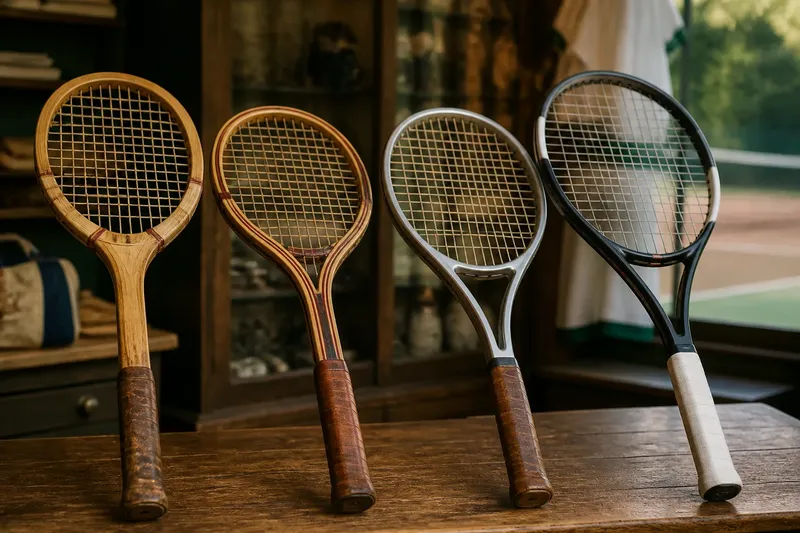
An old tennis racket hangs above the counter in a club shop, its narrow head and pale handle looking almost delicate beside a modern frame. Tennis racket materials did not change in one universal sequence: wooden, metal and composite designs overlapped, and makers explored different constructions at different times.
Wooden frames
Early lawn-tennis rackets were made from wood, shaped into a head and joined to a handle. The head was relatively small, and the strings formed a compact hitting area. Ash and other suitable timbers were used; the choice and construction varied by maker and period. Wood was familiar and workable, but it could bend or distort under the pull of tightly strung gut.
The material was only part of the design problem. A wooden frame had to hold its shape while supporting the strings, and the dimensions makers could use depended on the strength and behaviour of the timber. Players could choose among makers and models, but relatively modest heads remained characteristic of many wooden rackets.
Seen from the side, an old racket’s narrow rim and compact face offer clues to the design choices available to its maker. They do not measure the skill of the person who used it, nor do they identify every detail of its construction.
Laminated timber
Some makers improved wooden frames by bonding thin strips of timber together. Rather than relying on one substantial piece, they could arrange layers to build a structure suited to the strains imposed by strings and play. The result kept wood at its centre while changing how the frame was constructed.
A laminated frame is a little like a well-made chair built from layered sheets: the arrangement gives the material a job it might not perform as reliably in one thick piece. The comparison is imperfect, but it shows why construction mattered as much as the name of the wood.
At a chipped edge or in a close view, visible layers can point towards laminated timber. From across the court, however, the racket may look much like other wooden designs: a relatively small head, a continuous rim and a traditional throat joining head to handle.
Metal alternatives
Steel and aluminium frames offered alternatives to wood. They gave makers other ways to consider stiffness, weight and shape, but metal was not a single design and did not instantly displace timber. Different materials continued to coexist as manufacturers and players considered their respective qualities.
A metal rim may appear more uniform than layered wood, and metal allowed makers to explore forms that were difficult to produce from timber alone. The frame still had to balance strength, string tension, comfort and control. A different material brought a different set of design choices, not an end to trade-offs.
Imagine a club player choosing between a laminated wooden racket and an aluminium one. The wooden option represents one construction and feel; the metal option offers another way to shape the frame. Neither choice predicts how well the player will play. It identifies the kind of equipment each maker offered.
Composite designs
Composite frames combine materials rather than relying on a single timber or metal structure. Fibreglass and carbon fibre became important ingredients, often held in resin. These materials gave designers more scope to vary frame stiffness, weight distribution and geometry, and to create different head sizes and profiles.
That scope expanded the designs available, but it did not make every composite racket alike. Head size, beam shape and construction could vary. A larger string bed offers more room for contact, while a shaped beam gives designers another way to influence frame behaviour. These are design options, not promises of effortless power or accuracy.
Composite frames appeared alongside other materials, and players did not all change equipment at once. Models could preserve familiar outlines while changing what lay inside the rim. A match photograph may suggest a design period, but the image alone cannot establish the frame’s exact material.
Frame clues
When examining a racket in a museum display, a broadcast still or a family cupboard, look at several features rather than settling on one. Each clue narrows the possibilities; repairs, finishes and model variations can complicate the picture.
- Head size: Check whether the head is compact or broad. If it is compact, consider an older wooden design but seek more clues; if broad, consider later design possibilities without assuming a particular material.
- Rim surface: Look for wood grain or visible layers. If present, consider timber construction; if the finish is smooth and uniform, compare other clues rather than deciding between metal and composite from appearance alone.
- Beam shape: Inspect the rim’s thickness and contour. If the profile is varied, consider the broader design options associated with composites; if it is simple, keep other materials in contention.
- Throat and shaft: Note how the head joins the handle and whether the frame looks solid or open. If a feature suggests a familiar construction, record it as supporting evidence; if it is ambiguous, do not treat it as decisive.
- Strings and grommets: Inspect the holes and protective fittings around the rim. If they appear original, use them as further clues; if strings or fittings look replaced, give them less weight in dating or identifying the frame.
- Maker’s mark: Read the maker and model name, then compare them with product documentation. If the documentation identifies the construction, use it to check your visual impression; if no reliable match appears, leave the material uncertain.
Say you find a racket with a broad head, a smooth dark rim and a model name near the throat. Record those observations, then look for the maker’s description in a catalogue and compare it with the frame. If the documentation matches the model and construction, you have a stronger identification; if it does not, allow for a different version, a later finish or a repair instead of treating colour as proof.
What do the clues tell you?
Why laminate wooden frames?
Bonding thin strips let makers build a frame from arranged layers rather than one substantial piece. The method offered another way to manage the demands of strings and play while retaining timber construction.
Did metal replace wood at once?
No. Metal became an alternative, while different constructions remained available. Composite designs also emerged alongside other materials rather than marking a clean handover.
What is a composite frame?
A composite frame combines materials, commonly fibres held in resin. The term describes a family of constructions, not one uniform racket.
Can appearance identify a racket’s material?
Visible wood grain or layers can help, but finishes, repairs and model variation can mislead. For an exact identification, compare the racket’s markings with reliable maker documentation.
Inspection and use
Decide whether you want a broad sense of a racket’s period or an exact model identification. For a broad comparison, head shape, rim and visible construction may be enough. For a precise answer, record the maker, model, markings and signs of repair, then compare them with reliable product documentation. If the evidence conflicts, leave the material open rather than forcing a neat sequence onto an object that may have a less tidy history.
For a player considering an older racket, material history is only one part of the decision. Check the grip, strings, frame condition and suitability for the intended use. A cracked or altered frame may not be appropriate for play; a qualified racket technician can advise on its condition. Collecting and playing ask different things of the same object.
Tennis racket materials are best read as a range of constructions that overlapped: timber shaped and layered, metal explored as an alternative, and composites offering further design possibilities. When a racket appears in a display case or on screen, inspect its head, rim and construction before trusting a date or finish to tell the whole story.