The Quiet Geometry Behind a Crosscourt Rally
Crosscourt tennis geometry explains how the diagonal gives a ball more room to travel, helping viewers read direction without guessing how a point will end.

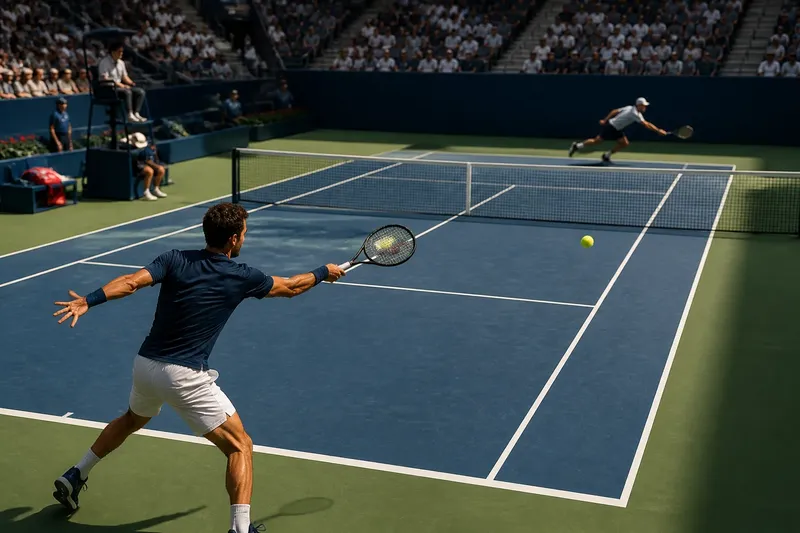
A player sends the ball from the right side of the baseline towards the far left corner, and the rally suddenly seems to have more room in it. That is crosscourt tennis geometry at work: the diagonal route crosses the court’s width as well as its length, creating a different set of margins from a shot hit straight ahead.
For a viewer, the useful point is not that crosscourt is automatically safer or better. It is that direction changes the available space and the opponent’s next position. The court’s lines explain part of the choice; the players’ locations explain the rest.
1. The diagonal is longer
A tennis court is a rectangle. From a player near one baseline corner, the opposite diagonal corner is farther away than the point directly ahead at the other baseline. The ball therefore travels along a longer path when it goes crosscourt than when it travels down the line.
That extra distance can make a crosscourt shot easier to keep in play, all else being equal. A ball travelling farther has more distance in which to descend towards the court after clearing the net. This is a geometric advantage, not a promise: height, pace, spin and contact point all affect where the ball lands.
Compare two imagined shots from the same place. One is aimed towards the far corner on the same side; the other is aimed diagonally to the far opposite corner. The second route is longer, so a player may have more room to send the ball with depth without asking it to land as close to the net as the shorter route would require.
Watch the receiver’s side of the court as well as the ball. A deep crosscourt shot can push an opponent towards the sideline, but a shorter or slower one may leave that player balanced and ready. The route gives the hitter a margin to work with; it does not decide what the receiver can do.
2. The net changes the route
The net is lower at its centre than at the posts. A diagonal shot travelling over the middle of the net has a lower obstacle than a shot that passes close to a post. Since a typical crosscourt path crosses nearer the centre, it can offer a more forgiving clearance line than a comparable down-the-line path near the sideline.
That does not mean players should aim blindly through the middle. The ball still needs to land inside the correct singles or doubles boundaries, and a central trajectory can give an opponent a more comfortable position. The useful distinction is between the route over the net and the intended landing point: a player can send the ball over the lower central part of the net while directing it towards a corner.
Imagine a player receives a ball near the baseline and chooses a high, deep crosscourt reply rather than a flatter shot close to the sideline. The higher arc can clear the net’s centre with room, while the diagonal target makes the far side of the court available. The observable result might be a ball that lands deep and makes the opponent move sideways, but the opponent may still return it well.
3. Singles lines narrow the target
The full court can look generous from the stands, but singles play uses the narrower singles sidelines. The doubles alleys are out of bounds in a singles rally. A crosscourt ball must therefore travel diagonally into a narrower target than the court’s outer rectangle suggests.
This is one reason a shot that appears to have plenty of space can still miss wide. From a low camera angle, the far sideline and the doubles alley may be hard to distinguish. The ball’s path can look safely inside the court while its landing point is beyond the singles line.
When watching, use the lines at the far end as a reference. The ball’s flight over the net tells you its direction; its bounce tells you whether the intended target was inside the singles boundary. On a broadcast, camera perspective can distort both distance and angle, so a close call is better left to the line-call system than to confident sofa geometry.
In doubles, the alleys become part of the court. That widens the available target at the sides, though it also changes where opponents position themselves. The same apparent diagonal can therefore have a different tactical meaning depending on whether two players or one are covering the receiving half.
4. Crosscourt shifts the opponent
A crosscourt shot often travels towards the opponent’s sideline, asking that player to move laterally. If it is deep, the receiver may have to cover distance while dealing with a ball near the baseline. If it is short, the receiver may have time to move forward and take the ball early. The direction alone does not tell you which situation the hitter has created.
Look for the combination of landing point and recovery position. After hitting crosscourt, a player commonly moves towards a position that covers the likely reply, but the exact location depends on the shot and the opponent’s options. If the hitter stays too far to one side, the down-the-line response may open space. If the hitter recovers towards the centre, the next crosscourt ball may still pull them wide again.
This is where the rectangle becomes a map of movement rather than a diagram on a broadcast graphic. One shot changes the opponent’s location; the reply then changes the hitter’s. Each player is balancing the open court against the direction from which the next ball might come.
Say you see an invented rally begin with both players near the baseline, and one sends a deep ball crosscourt towards the receiver’s backhand corner. The receiver reaches it and returns down the line into the space left open. The first shot created lateral movement, but it did not dictate the next shot or settle the point; the receiver’s position and the available angle shaped the reply.
5. A crosscourt angle has limits
It is tempting to treat crosscourt as a shortcut to the sideline. Yet the ball’s angle depends on where contact occurs and where the player is aiming. A ball struck well inside the court can be directed at a sharp angle, while a ball contacted near the sideline may have less room to travel farther outwards before it leaves the legal court.
Players also vary the shape of the shot. Topspin can bring a ball down sooner after it clears the net, while slice may produce a lower, skidding bounce. A high, heavy ball and a flat drive can share a crosscourt direction but ask different questions of the receiver. Viewers can note the arc and bounce without treating them as clues to a certain winner.
The opponent’s position matters too. If the receiver is already standing near the sideline, a crosscourt ball may find them rather than move them. If they are closer to the centre, the same target may require a sharper change of direction. Geometry describes the available route; court position determines how demanding that route is likely to be.
6. What should viewers watch?
Why is crosscourt often a comfortable rally direction?
The diagonal route is longer than the straight route to the far end, and it commonly crosses over the lower centre of the net. Those features can provide more margin for a rally ball, though placement and execution still matter.
Does crosscourt always move the opponent?
No. A shot aimed towards a sideline can pull an opponent wide if they are positioned nearer the centre, but a player already near that side may reach it without much movement. Watch where the receiver starts and where the ball lands.
Why do crosscourt shots sometimes go wide?
The target in singles is bounded by the singles sideline, not the outer doubles line. A sharp angle, an off-centre contact point or a misjudged trajectory can send the bounce beyond that boundary.
Is down the line riskier?
It often offers a shorter route and may pass nearer a higher part of the net, leaving less room for error in some situations. But the choice depends on contact point, target, opponent position and the shot being played, so direction is not a verdict on risk by itself.
Read the whole shape
The simplest way to read a crosscourt rally is to follow three things in order: the hitter’s contact point, the ball’s route over the net and the bounce relative to the singles sideline. Then look at the receiver’s movement and recovery. That sequence turns a diagonal into a visible exchange of space rather than a prediction about who will win.
Crosscourt tennis geometry is most useful when treated as a set of constraints, not a forecast. The court gives the ball a longer diagonal and a lower central net to cross; the players decide how to use those margins, and the next shot remains an open question. Like a book propped open with a finger, the geometry holds one possibility in place while the rally keeps moving.